
Blog
Functional vs. Decorative Swords: How to Tell the Difference Before You Buy

Will this sword actually hold up if I swing it, or is it just meant for the wall?
If you’ve asked yourself that, you’re already thinking like a smart buyer. It’s the single most important question in this hobby, and getting the answer wrong costs people money, ruins gifts, and — in the worst cases — sends a broken blade flying across a backyard.
The confusion is understandable. A $60 stainless “samurai sword” on a marketplace listing and a $400 clay-tempered katana from a proper forge can look almost identical in photos. Both are shiny. Both are sharp-ish. Both get called “battle-ready” by someone trying to sell them. The differences that actually matter are mostly invisible until you know exactly where to look.
This guide fixes that. By the end you’ll be able to:
- Tell a functional sword from a decorative sword using six concrete checks
- Spot the myths and marketing tricks that trip up first-time buyers
- Identify a sword you already own — inherited, secondhand, or found in the shed
- Recognise the red flags of a scam listing before you hand over money
- Choose the right type of sword for how you actually plan to use it
Let’s start with the fast version.
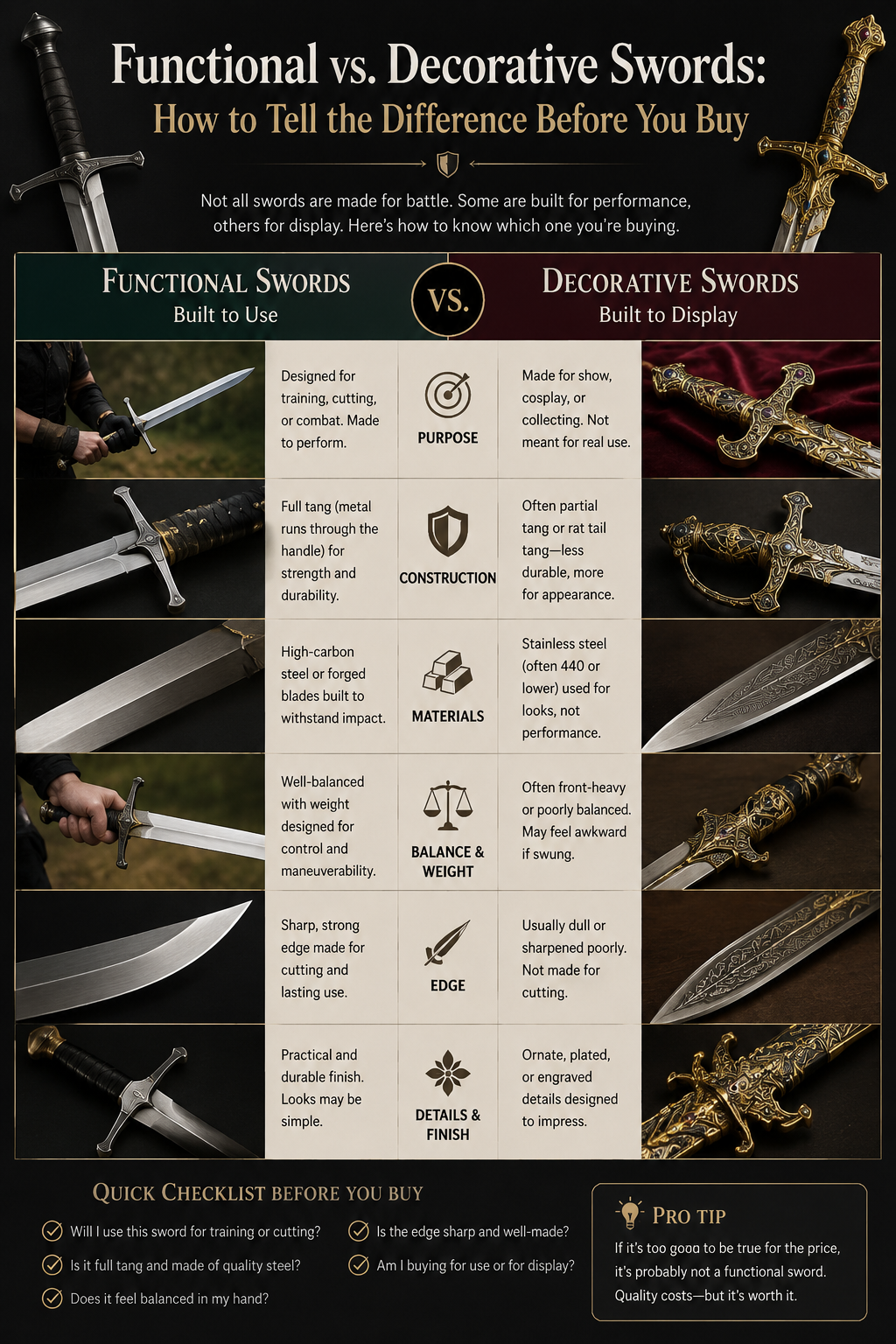
Quick Comparison Table: Functional vs. Decorative at a Glance
| Feature | Functional Sword | Decorative Sword (Wall Hanger) |
|---|---|---|
| Purpose | Cutting, martial arts, hard-use practice | Display, cosplay, costume, ornament |
| Blade steel | High-carbon or spring steel (1045, 1060, 1095, T10, 5160, 9260) | Stainless steel (400-series), unmarked “steel,” or cast alloy |
| Tang construction | Full or properly fitted tang, secured through the handle | Rat-tail / stick tang, often welded, held by a pommel nut |
| Heat treatment | Hardened and tempered (sometimes differentially) | Little or none; “hamon” is often acid-etched, purely cosmetic |
| Edge | Can be sharp or shipped blunt; geometry built for cutting | Sometimes sharp, sometimes dull — sharpness is cosmetic |
| Weight | Historically accurate: roughly 1–1.6 kg for most one/two-handers | Often too heavy and clumsy, or oddly light and hollow |
| Balance | Lively; point of balance usually 7–15 cm ahead of the guard | Dead, blade-heavy, or unbalanced |
| Durability | Survives impact and lateral stress | May bend, chip, or snap under real force |
| Maintenance | Needs oiling (carbon steel rusts); reward for the effort | Low — stainless resists rust, but that’s its only advantage |
| Safety when used | Designed to be swung and cut with | Not safe to swing — can fail catastrophically |
| Typical price | ~AUD $150–600+ (entry to quality) | ~AUD $20–120 |
| Ideal buyer | Practitioners, cutters, serious collectors | Display buyers, cosplayers, gift-givers |
The one-line rule of thumb: Steel type tells you what a sword is made of. Tang and heat treatment tell you whether it will survive being used. A “high carbon steel” blade with a welded rat-tail tang is still a wall hanger.
What Functional and Decorative Swords Actually Mean
What Is a Functional Sword?
A functional sword — often marketed as “battle-ready” — is built to survive being used. That means proper steel, real heat treatment, and a tang strong enough to take the shock of a cut without the blade parting company with the handle.
A true functional sword can be used for test cutting (tameshigiri on rolled mats, water bottles, or tatami), for martial arts training, or for serious collecting where authenticity of construction matters. It’s a tool first and an ornament second.
Importantly, “functional” does not automatically mean “sharp.” Plenty of functional blades ship blunt or only mildly sharpened, because putting a razor edge on good steel is the easy part. The hard part — the part you’re paying for — is everything underneath.
What Is a Decorative Sword?
A decorative sword (also called a display sword or wall hanger) is made to be looked at, not swung. It prioritises appearance and price over structural integrity. This isn’t a scam in itself — decorative swords are a legitimate, popular product for display, cosplay, film replicas, and gifts.
The problem is only when a decorative sword is sold as a functional one. A wall hanger is perfectly safe hanging on a wall. It becomes dangerous the moment someone believes the “battle-ready” label and takes it out to the yard.
Why the Terms Are Often Misused by Sellers
Here’s the uncomfortable truth: “battle-ready” is not a regulated term. No standards body defines it. Anyone can print it on a listing.
That’s why you’ll see $40 swords described in exactly the same language as $400 ones. Some sellers genuinely don’t know the difference. Others know precisely, and count on you not knowing. Either way, the label is worthless on its own — you have to verify the actual specs, which is what the next section teaches you to do.
The 6 Most Reliable Ways to Tell Them Apart
1. Blade Steel
Steel is where most buyers start, so let’s get the vocabulary straight.
- Stainless steel (400-series, e.g. 420, 440): Contains chromium to resist rust. Excellent for kitchen knives; poor for long blades. Over about 30 cm, stainless becomes brittle and prone to snapping under stress. For a full-length sword, treat “stainless” as a strong signal that it’s decorative.
- 1045 carbon steel: ~0.45% carbon. The entry point for genuinely functional blades. Softer and more forgiving, holds up to light cutting when properly treated. Budget-friendly.
- 1060 carbon steel: ~0.60% carbon. A sweet spot of hardness and toughness. Durable, forgiving, and one of the best all-round choices for beginners.
- 1095 carbon steel: ~0.95% carbon. Harder, holds a keener edge, but less forgiving of sideways impact. Common in clay-tempered katanas.
- T10 tool steel: A tungsten alloy (~1% carbon). Tough, resists chipping, takes a great edge. A step up in price and quality.
- Spring steels (5160, 9260): Extremely tough and flexible. A 9260 blade can flex dramatically and spring back true. Favoured for hard-use European swords and serious cutters.
Now the critical point most listings won’t tell you:
Steel alone does not determine functionality. A well heat-treated 1045 blade will outperform a badly heat-treated 1095 blade every time. “High carbon steel” on a label means nothing if the blade was never properly hardened and tempered.
2. Tang Construction
The tang is the unsharpened portion of the blade that extends into the handle. It’s the most important structural feature of any sword — and the one decorative makers cut corners on most.
- Full tang: The tang runs the full length of the handle and matches the blade’s width or profile. On European swords it’s often peened over the pommel; on Japanese swords the equivalent (the nakago) runs most of the handle and is pinned with bamboo pegs (mekugi). This is the gold standard.
- Partial tang: Extends only part way into the handle. Weaker, and a warning sign in a sword sold for use.
- Rat-tail / stick tang: A thin rod — frequently welded to the blade — running through the handle and held by a threaded pommel nut. The weld is a weak point. Under a hard swing or an impact, the blade can snap off at the weld.
⚠️ Critical safety warning — the “helicopter” failure mode: A welded rat-tail tang is the classic cause of catastrophic sword failure, and it’s worth understanding why. When you swing a sword it acts as a long lever, and the stress of that motion concentrates at the thinnest point — the weld where the rod meets the blade shoulder. That weld can let go instantly and without warning, launching a heavy, sharp blade across the room while you’re left holding a hollow handle. This is the single biggest reason never to swing a decorative sword.
Two ways to check the tang without taking anything apart:
- The wiggle check. Hold the handle and gently try to move the blade. Any wobble, click, or rattle points to a loose or poorly fitted tang. A sound sword feels like one solid piece.
- The hilt tap (resonance) test. Hold the grip firmly with the blade pointed safely upward, make a loose fist with your other hand, and give the base of the grip or the pommel a firm bump with the heel of your palm. A structurally sound sword rings with a short, clean, metallic note and passes the vibration into your hand as a single unit. A distinct buzz, rattle, or dull hollow sound means a loose tang, a poor weld, or a blade floating in a pocket of glue — treat it as decorative. It’s an indicator, not a lab test, but it’s a genuinely useful two-second check at a market stall or pawn shop.
Assembly markers differ across sword types, so it helps to know both:
- European swords. The strongest builds use a peened pommel — the tang is passed all the way through and hammered over to lock everything together permanently. A thin threaded rod topped with a small hex nut, or a zinc/pot-metal pommel, is a red flag.
- Japanese swords. A real mekugi (bamboo peg) passes through a hole in the tang and can be removed. A handle with a cast-in, non-functional “peg” that won’t come out means the tang isn’t actually pinned — a decorative giveaway.
Two nuances worth keeping in mind: a full tang made of brittle stainless is still unsafe, and not every narrow or threaded tang is automatically bad if it’s properly made. But for a beginner, “welded rat-tail = decorative” is a reliable default.
3. Heat Treatment and Tempering
This is the invisible step that separates a real sword from a shiny bar of metal.
- Hardening (quenching): The blade is heated and rapidly cooled to make the steel hard enough to hold an edge.
- Tempering: The hardened blade is gently reheated to remove brittleness. Skip this and you get glass-hard steel that shatters. Tempering is non-negotiable for a functional blade.
- Through-hardening: The whole blade is hardened uniformly. Perfectly serviceable.
- Differential hardening (clay tempering): Clay is applied to the spine before quenching, so the edge cools fast (hard) while the spine cools slower (tough). The result is a hard cutting edge with a shock-absorbing spine — and a genuine hamon (temper line).
Real hamon vs. fake hamon: A real hamon is a metallurgical feature with subtle depth and irregular “activity” that follows the actual hardness transition. A fake hamon is acid-etched or wire-brushed onto the surface — usually too uniform, too wavy in a cartoonish way, and purely cosmetic. A fake hamon doesn’t always mean a bad sword, but it does mean no differential hardening happened there. If a cheap listing shows a suspiciously perfect, painted-on temper line, be skeptical.
A quick note on hardness (HRC): Functional blades are heat-treated to a measurable hardness on the Rockwell C scale. Through-hardened swords usually land around 50–55 HRC — a range chosen for toughness, so the blade flexes and absorbs impact instead of shattering. Differentially hardened katanas run harder at the edge (roughly 58–62 HRC) with a much softer, springier spine. Reputable sellers publish this figure. Decorative pieces almost never do, because they were never properly hardened to begin with.
4. Edge Geometry and Sharpness
Let’s kill the most stubborn myth right here:
Sharp does not mean battle-ready. Sharpness lives on the very edge of the blade. Functionality lives in the whole blade’s ability to survive impact. A decorative stainless sword can be honed to a razor and still snap the first time it hits something.
A functional sword’s edge geometry is built for cutting — an appropriate edge angle backed by good steel and heat treatment. Many quality functional swords arrive blunt precisely because sharpening is trivial to add later, whereas correct geometry and metallurgy cannot be added at all. Don’t let a keen edge on an unknown sword convince you it’s built to be used.
5. Weight and Point of Balance
People consistently expect swords to be heavy. Real ones aren’t.
- A one-handed arming sword typically weighs ~1–1.5 kg.
- A two-handed longsword is usually ~1.1–1.6 kg.
- A katana generally sits around ~1–1.3 kg.
The point of balance (PoB) — where the sword balances on one finger — usually sits 7–15 cm forward of the guard for cutting swords. A well-made sword feels alive and responsive, not like swinging a crowbar.
Good balance isn’t an accident. It comes from distal taper — the blade gradually thinning from base to tip (as well as narrowing in profile). That taper strips weight from where you don’t want it, so the sword feels quick rather than tip-heavy. Many decorative blades are a uniform thickness the whole way down, which is precisely why they handle like a crowbar and feel dead in the hand.
Warning signs of a decorative piece:
- Noticeably overweight and clumsy, with the weight dumped out toward the tip (common in cheap cast blades)
- Oddly light, hollow, or “toy-like” in the hand
- A guard or pommel that feels like cast pot-metal rather than solid forged fittings
Heavy is not a sign of quality. Historical swords were agile weapons, not sharpened clubs.
6. Seller Transparency and Product Information
How a sword is described is often the clearest signal of what it is. A reputable seller of functional swords will happily list:
- Exact steel (e.g. “1060 high carbon steel, clay tempered”), not just “high carbon steel”
- Tang type (“full tang”)
- Weight and point of balance
- Overall length, blade length, and handle length
- Hardness (HRC) where relevant
- Edge status (sharpened or blunt)
- Whether the blade has been cut-tested
If a listing hides all of this behind the word “battle-ready,” the silence is the answer.
Common Myths That Mislead Sword Buyers
Myth #1: “Full tang means it’s safe”
A full tang is necessary but not sufficient. A full tang made of brittle stainless, or one poorly assembled, can still fail. Tang and heat treatment and steel all have to be right.
Myth #2: “High carbon steel means functional”
“High carbon steel” is a material, not a guarantee. Without proper hardening, tempering, and a sound tang, it’s just a spec on a page. And “high carbon” is sometimes marketing spin over unremarkable steel.
Myth #3: “Sharp equals battle-ready”
Sharpness and structural integrity are completely independent. A razor edge on a wall hanger just makes a dangerous object and a fragile one.
Myth #4: “Expensive means authentic”
Price can reflect ornate fittings, brand name, or gold-plated decoration rather than blade performance. There are beautiful, overpriced wall hangers — and modest-priced forge blades that cut superbly. Judge the construction, not the sticker.
Myth #5: “Heavy means better quality”
Excess weight usually signals poor design or cheap casting, not strength. Balance and agility are the marks of a good sword.
Myth #6: “Hand-forged means functional”
“Hand-forged” describes how a blade was shaped, not whether it works. A carefully ground “stock-removal” blade from a good maker can be fully functional, while a “hand-forged” blade with no proper heat treatment or a welded tang is still a wall hanger. Like “battle-ready,” it’s a term that sounds reassuring and guarantees nothing on its own — the heat treatment and the tang are what decide the outcome.
How to Identify a Sword You Already Own
Inherited a sword? Bought one secondhand? Found one in a relative’s shed? Here’s a practical inspection checklist. Work through it gently — and read the safety warning at the end before you touch anything with a cloth.
Visual Inspection
- Note the overall condition: patina, rust, scratches, wear.
- Look for markings: maker’s stamps, signatures, serial numbers, or import stamps (“Made in…”).
- Assess the fittings — are the guard and pommel solid and well-finished, or cast with visible seams?
Checking Tang Clues
- On some swords (a katana’s mekugi peg, for example) the tang can be safely revealed and may carry a signature (mei), file marks, and age-indicating patina.
- A rust-patinated tang on an old blade can indicate genuine age. Do not clean it — that patina is exactly what an appraiser uses to date the sword.
Looking for Steel Information
- Check the blade surface for stamps, etched markings, or a folding/lamination pattern (hada) that can hint at construction method.
Signs It May Be Decorative
- Chrome-bright, mirror-shiny stainless
- Cast handle and guard with mould seams
- A screw-on pommel nut and a thin rod visible where the handle meets the blade
- Very light, hollow feel
- Came with a wall-mount plaque or bracket
- Purely ornamental engravings with no functional fittings
Signs It May Be Functional
- A genuine hamon or evidence of differential hardening
- A solid full or well-fitted tang
- Quality steel markings
- Real patina on an older blade, or evidence of a professional polish
- Solid, forged (not cast) fittings
When Not to Disassemble a Sword
Leave it assembled if the sword may be a genuine antique, if the fittings are tight or historical, or if you’re simply unsure. Forcing pegs or pommels can crack fittings and destroy value.
⚠️ Important safety and value warning: Do not sand, grind, buff, polish, or “restore” a potentially valuable or antique sword. Amateur cleaning destroys patina and can permanently ruin a genuine antique — abrasive rust removal is irreversible. If you suspect the sword is old or valuable, consult a professional appraiser. For Japanese swords, only a trained polisher (togishi) should ever touch the blade. When in doubt, do nothing and get it assessed.
How to Avoid Sword Buying Scams Online
The same knowledge that tells you functional from decorative also protects you from misleading listings. Run any listing through this red-flags checklist.
Walk away when you see:
- Unrealistically cheap prices — a “hand-forged, full-tang, battle-ready katana” for $30 does not exist. Do the maths: proper carbon steel, the furnace time and fuel to harden and temper it, a sound tang and fittings, sharpening, a scabbard, and shipping all carry a hard cost floor. A genuinely functional sword can’t be produced and delivered at that price, so the number itself is proof it’s a wall hanger.
- “Hand-forged” waved around as proof of quality — on its own it means nothing (see Myth #6). Look for the steel grade and tang details behind the buzzword.
- Missing specifications — no steel type, no tang information, no weight, no measurements.
- “Battle-ready” as the only descriptor — with nothing to back it up.
- Contradictory claims — “440 stainless steel battle-ready sword” is a contradiction; stainless is a display material for long blades.
- Generic or stolen photos — stock images or pictures that appear on multiple unrelated stores. Reverse-image-search them.
- Too-perfect or copy-pasted reviews — identical phrasing, no verified purchases, all five stars posted in the same week.
- No manufacturer or brand information.
- No return or refund policy — a confident seller stands behind their product.
A practical example: A listing reads “Battle Ready Samurai Katana, High Carbon Steel, Full Tang — $39, Free Shipping.” Sounds great. But there’s no specific steel grade, no HRC, no weight, no PoB, the photos appear on four other stores, and returns aren’t mentioned. Every real detail is missing and every marketing buzzword is present. That’s a decorative sword wearing a functional costume.
Which Type of Sword Should You Buy?
There’s no single “best” sword — only the best sword for your purpose. Match the tool to the job.
For Display and Decor
A decorative sword is the right, cost-effective choice. Buy what looks good to you, and mount it securely and safely out of reach of children.
For Cosplay
Prioritise a lightweight, blunt piece. It’s easier to carry and safer around crowds — and many conventions require blunt or peace-bonded props. A functional sharp blade is the wrong tool here.
For Historical Collecting
It depends on your goal. Genuine antiques should be appraised and bought from reputable dealers. For reproductions, buy high-quality functional pieces from respected forges, and prioritise authenticity of construction and provenance.
For Martial Arts
Match the sword to the discipline. Iaido often uses an unsharpened iaito (alloy practice sword). HEMA uses blunt steel trainers and feders. Always confirm what your school or instructor requires before buying.
For Cutting Practice (Tameshigiri)
You need a genuinely functional, sharp blade — proper heat treatment, a sound full tang, and durable steel such as clay-tempered 1060/1095/T10 or spring steel (5160/9260). This is where corners cut become injuries.
For Gifts
For a display gift, a decorative sword is ideal. If the recipient actually practises, get their input first. And never gift a sharp functional sword to a minor — check your local rules on sales and ownership.
Safety Considerations Every Beginner Should Know
Owning a sword responsibly is straightforward once you build the habits.
- Storage: Keep blades dry. Oil carbon-steel blades to prevent rust. Store in a scabbard or on a proper rack, away from children, and ideally secured or locked.
- Handling: Never swing indoors or anywhere near people or pets. Respect the edge, keep control of the blade, and use two hands where the sword is designed for it.
- Transportation: Keep the sword sheathed and cased, transport it discreetly, and don’t handle it in public.
- Maintenance: Wipe the blade after handling — fingerprints cause rust on carbon steel. Use a light machine oil or mineral oil (choji oil for katanas), and periodically check that fittings haven’t worked loose.
⚠️ Legal note (general only): Sword laws vary widely between countries, states, and regions, and can cover buying, owning, carrying, importing, and selling to minors. This guide is general information, not legal advice — always check the current laws in your own area before you buy or take a sword anywhere.
Responsible ownership isn’t complicated. It’s mostly respect for the blade and awareness of the people around you.
Frequently Asked Questions
Can decorative swords be sharpened?
Physically, yes — but sharpening doesn’t make a decorative sword functional. A sharpened stainless wall hanger is arguably more dangerous, because it’s now both fragile and keen. It’s not recommended.
What does “battle-ready” actually mean?
It’s an unregulated marketing term. It’s supposed to mean the sword has the steel, heat treatment, and tang to survive cutting and impact — but because no standard enforces it, you must verify the actual specifications rather than trust the label.
Are stainless steel swords always decorative?
For full-length swords, effectively yes. Stainless becomes brittle in long blades and should be treated as display-only. Stainless is perfectly fine for shorter knives.
What is a rat-tail tang?
A thin rod — often welded to the blade — that runs through the handle and is held by a pommel nut. The weld is a weak point that can fail under stress, which is why it’s a hallmark of decorative construction.
Can a decorative sword break if swung?
Yes. The blade can snap — especially at a welded tang or in brittle stainless — and the broken piece can fly off. It’s a genuine injury risk. Don’t swing decorative swords.
How much should a functional sword cost?
Realistically, entry-level functional swords start around AUD $150–300, with quality clay-tempered or spring-steel pieces running $300–600+. A sub-$50 “battle-ready” sword is a red flag. (Prices are approximate and vary by maker and materials.)
Is a sharp sword automatically functional?
No. Sharpness is independent of structural integrity. A sword can be sharp and still fail under real use.
What is the best steel for beginners?
1060 high carbon steel is a great all-rounder — tough, forgiving, and affordable. 1045 is a solid budget option, and 5160 spring steel is excellent if you want extra durability for cutting.
How do I identify an inherited sword?
Inspect the markings, construction, and condition, and look for a maker’s mark — but don’t clean or polish it. If it might be an antique, get a professional appraisal before doing anything else.
Are decorative swords worth collecting?
They can be, for their artistry, themes, and film-replica or display value. Just collect them as display pieces — not for use — and be aware they generally don’t appreciate the way genuine antiques do.
What is a wallhanger sword?
“Wallhanger” is collector slang for a decorative, display-only sword — typically stainless or alloy with a rat-tail tang. The name says it all: it’s built to hang on a wall, not to be swung or cut with.
Why is stainless steel fine for knives but not for swords?
It comes down to length. The chromium that makes stainless rust-resistant also makes it more brittle. In a short knife blade that brittleness is a non-issue, but in a long sword blade it creates a real risk of snapping under stress. Short is fine; long is display-only.
What’s the difference between a functional sword and a stage-combat sword?
Stage-combat (theatrical) swords are a specialised category — usually tough spring steel with deliberately blunt, thick “rebated” edges built to survive repeated blade-on-blade contact without cutting anyone. They’re robust, but they’re made for choreographed contact, not for sharp cutting or as accurate replicas.
Can I convert a decorative sword into a functional one?
Not practically or safely. The things that make a sword functional — the steel’s composition, its heat treatment, and a sound tang — are locked in at manufacture and can’t be retrofitted. Rehandling won’t fix brittle stainless, and you can’t add proper hardening to a finished blade. Buy the right sword from the start instead.
What is “spring temper”?
It’s a heat treatment that lets a blade flex under load and spring back straight instead of taking a permanent bend. Spring steels like 5160 and 9260 are known for it, and it’s a hallmark of a durable, hard-use functional sword.
Are anime or movie replica swords safe to swing?
Almost always no. Replica and “collector” swords are typically decorative stainless display pieces made to look the part, not to be used. Enjoy them on a stand or wall — don’t swing them.
What is a peened tang?
A construction method common on quality European swords: the tang passes all the way through the pommel and its end is hammered (peened) over to lock the whole sword together permanently. It’s a sign of solid, functional assembly, as opposed to a threaded rod held on by a nut that can work loose over time.
Conclusion: Buy With Confidence
The difference between a functional and a decorative sword comes down to a few things you can now check for yourself: the steel, the tang, the heat treatment, the edge and balance, and — just as revealing — how honestly the seller describes it.
Remember the essentials:
- “Battle-ready” is marketing, not a guarantee — verify the specs.
- Steel type matters, but tang and heat treatment decide whether a sword survives use.
- Sharp does not mean functional; heavy does not mean quality.
- Never swing a decorative sword.
- If you’ve inherited an old blade, don’t clean it — get it appraised.
Whether you’re after a functional blade to cut with, a display piece for the wall, or a prop for your next event, the right choice is the one that matches how you’ll actually use it — bought from a seller who tells you exactly what you’re getting.
Ready to shop with confidence? Browse our fully-specced Functional Swords collection for blades built to be used, or explore our Decorative Swords collection for display and cosplay pieces — every listing spells out the steel, tang, and construction, so you always know precisely what’s arriving at your door.
